A sagging shelf may seem like a minor issue, but it can quickly become a safety concern if left untreated. Whether you use your shelves for books, kitchen essentials, decorative items, or office supplies, a shelf that bends or droops in the middle often indicates a support problem that should not be ignored. The good news is that you do not always need to replace the entire shelf. In many cases, learning how to stabilize a sagging shelf with a screw is enough to restore its strength and prevent further damage.
This guide explains why shelves sag, when a single screw can solve the problem, and when additional support or replacement is the better choice. You’ll also learn common DIY mistakes to avoid and expert tips to make your repair last for years.
Quick Answer
Yes, you can stabilize a sagging shelf with a screw if the problem is caused by a loose mounting point rather than a permanently bent shelf. The screw should be driven into a solid wall stud whenever possible. If there is no stud behind the shelf, a heavy-duty toggle bolt provides much better support than a standard drywall screw. However, if the shelf itself has warped or carries more weight than it was designed to hold, adding a center bracket or replacing the shelf is the better long-term solution.
Why Does a Shelf Start Sagging?
Before picking up your drill, it helps to understand why shelves sag in the first place. A screw can only fix certain problems, so identifying the real cause saves time and prevents unnecessary repairs.
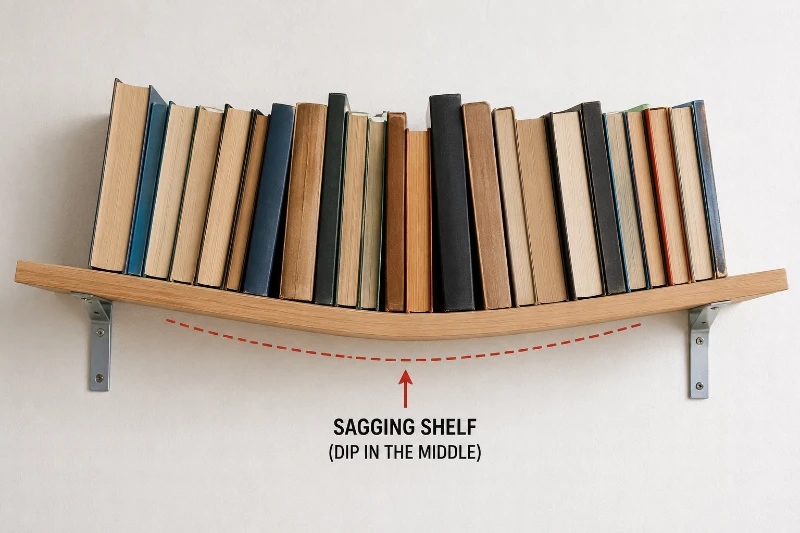
Most shelves begin sagging because of one or more of these reasons:
- Too much weight on the shelf
- Weak shelf material
- Poor installation
- Loose mounting hardware
- Lack of center support
Sometimes the shelf itself is perfectly fine, but the mounting screws slowly loosen over time. In other cases, the shelf material permanently bends under continuous weight.
Heavy Loads
Every shelf has a weight limit. When that limit is exceeded, the shelf begins to flex. Books, dishes, storage boxes, and large decorative items place constant pressure on the center of the shelf.
Even if the shelf does not fail immediately, months of continuous weight can cause permanent sagging.
A good habit is to spread heavy objects evenly instead of placing everything in the middle.
MDF Shelves Sag Faster Than Solid Wood
Medium Density Fiberboard (MDF) is one of the most common shelf materials because it is affordable and smooth. However, it is much less resistant to bending than solid wood.
Many homeowners searching for how to stop MDF shelves sagging discover that the material gradually loses its strength under constant weight. Once MDF begins to bow, it rarely returns to its original shape.
If your MDF shelf stores heavy books or kitchen appliances, adding a center support early can prevent permanent damage.
Floating Shelves Have Different Problems
Floating shelves often sag for completely different reasons.
Most floating shelf problems happen because:
- The mounting screws only grip drywall.
- The bracket missed the wall stud.
- The shelf exceeds the manufacturer’s weight rating.
- Cheap wall anchors were used.
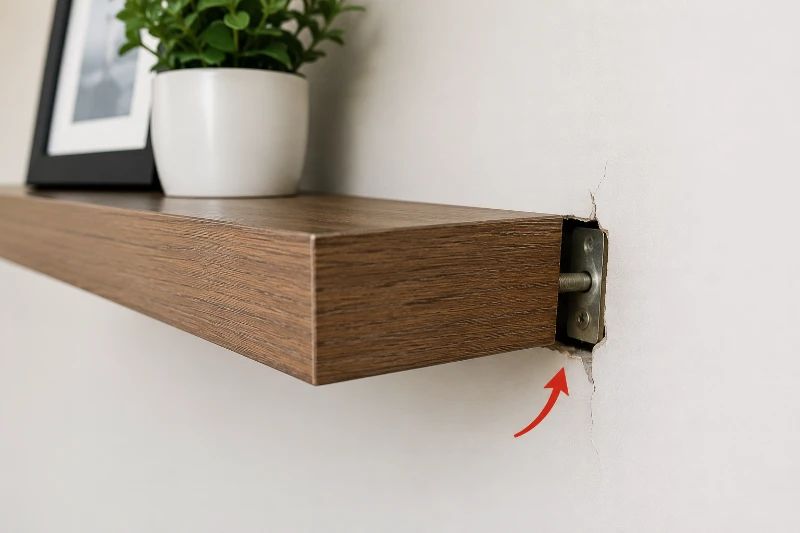
If you’ve read discussions about floating shelf sagging, you’ll notice the same issue appears repeatedly. The shelf itself is usually not defective—the installation lacks adequate support.
Even a high-quality floating shelf will eventually droop if it is overloaded or improperly anchored.
Safety First Before You Start
Before drilling into any wall, take a few minutes to prepare.
Always:
- Remove everything from the shelf.
- Wear safety glasses.
- Turn off power if drilling near electrical outlets.
- Check for hidden electrical wiring or plumbing.
- Use a sturdy ladder if the shelf is mounted high on the wall.
These simple precautions reduce the risk of accidents and make the repair much easier.
Can One Screw Fix a Sagging Shelf?
The answer depends on what caused the sagging.
A single screw works well when the shelf has lost support at one mounting point, but the shelf itself is still structurally sound.
A screw can often solve problems such as:
- A loose center support
- A shelf bracket pulling away from the wall
- A bookshelf with a loose mounting point
- Cabinet shelves that have shifted slightly over time
In these situations, tightening or adding one correctly positioned screw restores the connection between the shelf and its support.
However, if the shelf has permanently bowed or cracked, no screw can reverse that damage.
How to Stabilize a Sagging Shelf With a Screw
Step 1: Identify the Cause of the Sag
Start by examining the shelf carefully.
Press gently along different sections.
Ask yourself:
- Does only the center sag?
- Is one side lower than the other?
- Is the bracket loose?
- Does the shelf move when pressed?
Finding the exact weak point makes the repair much more effective.
Step 2: Locate a Wall Stud
This is the most important step.
A screw only provides lasting support when it bites into solid wood.
Use a stud finder if possible.
If you do not have one, lightly tap the wall.
A hollow sound usually means drywall.
A solid sound usually indicates a stud.
Whenever possible, install your screw directly into the stud.

Expert Tip
A screw anchored into solid wood can support significantly more weight than one installed only in drywall. Spending a few extra minutes locating a stud often determines whether the repair lasts for years or fails within weeks.
Step 3: No Stud? Use a Heavy-Duty Toggle Bolt
Sometimes the ideal location does not line up with a wall stud.
In that case, avoid using ordinary plastic wall plugs.
Instead, install a heavy-duty toggle bolt.
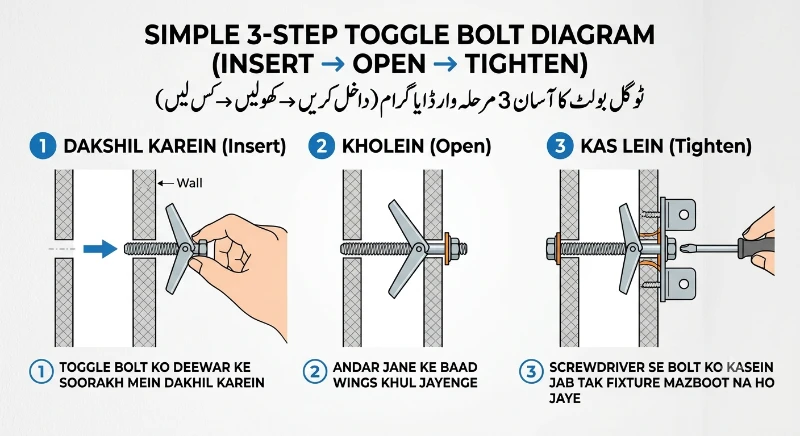
A toggle bolt opens behind the drywall, spreading the load over a much larger area, making it one of the strongest options for hollow walls.
Although it is not as strong as a stud connection, it performs far better than a regular drywall screw.
Step 4: Drill a Pilot Hole
If the shelf is made from MDF, particleboard, or plywood, always drill a pilot hole first.
Skipping this step increases the chance of:
- Cracked shelf material
- Split wood
- Loose screw threads
- Uneven screw placement
A pilot hole also helps the screw drive in smoothly without damaging the shelf.
Step 5: Drive the Screw at a Slight Upward Angle
This small technique makes a surprisingly big difference.
Instead of driving the screw perfectly straight, angle it slightly upward toward the wall stud.
Doing this helps counteract the downward force that caused the shelf to sag.
The shelf remains tighter against the wall and is less likely to loosen over time.
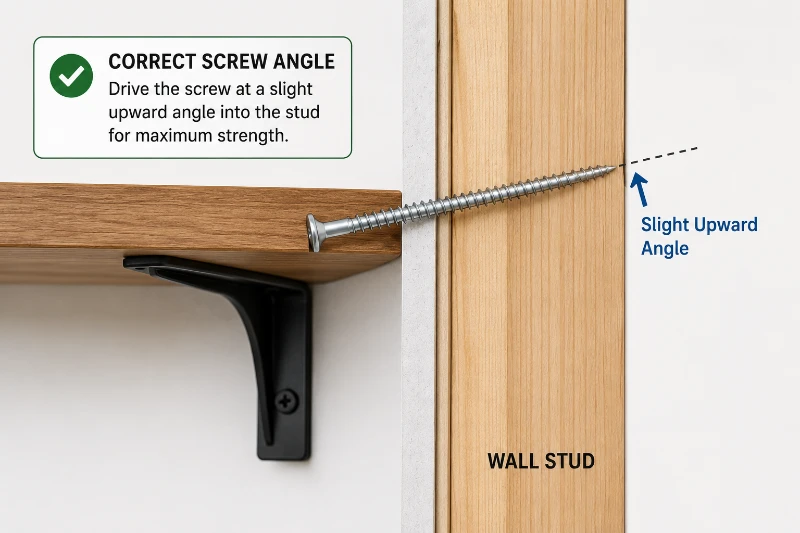
Pro Tip
Choose a screw long enough to penetrate at least 1½ inches into the wall stud. Short screws often feel secure initially but gradually loosen under repeated weight.
Step 6: Test the Repair
Before putting everything back on the shelf, test your work.
Press gently on the shelf.
Check whether:
- The shelf feels firm.
- The bracket stays tight.
- There is no movement.
- The shelf sits level.
If the shelf still flexes noticeably, the screw may have missed the stud, or the wall anchor may not be properly seated.
Common Mistakes That Make Shelf Repairs Fail
Many DIY shelf repairs fail for the same reasons.
Avoid these common mistakes:
- Screwing Into Drywall Alone: Drywall cannot support heavy shelves by itself. A screw without proper backing will eventually loosen.
- Using Short Screws: A screw that barely reaches the stud provides very little holding strength.
- Ignoring Weight Limits: Adding another screw will not solve the problem if the shelf is overloaded every day.
- Skipping the Pilot Hole: MDF and particleboard split easily without pilot holes.
- Reusing Damaged Hardware: Old screws, worn brackets, and stripped anchors should always be replaced rather than reused.
Which Repair Works Best?
| Problem | Best Solution |
| Loose mounting screw | Tighten or replace the screw |
| Shelf missed the wall stud | Install a screw directly into the stud |
| No stud available | Use a heavy-duty toggle bolt |
| Bent MDF shelf | Replace the shelf or add center support |
| Overloaded shelf | Reduce the weight before repairing |
| Broken shelf bracket | Replace the damaged bracket |
When One Screw Is Not Enough
Although a single screw can solve many shelf problems, it is not a universal repair. Sometimes the issue is not the mounting hardware but the shelf itself. If the board has permanently bowed, cracked, or become too weak to support its load, tightening screws will only provide a temporary improvement.
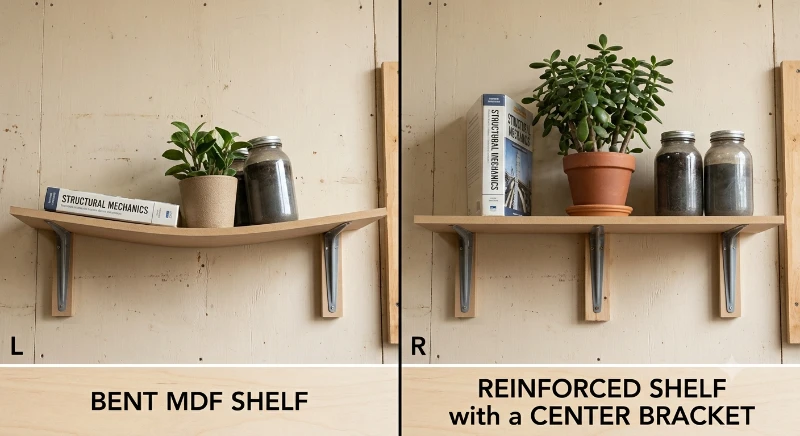
Knowing when to stop repairing and start reinforcing can save both time and money.
Permanently Bent Shelves
If your shelf has a noticeable curve even after removing all the weight, the material has likely warped permanently.
This is especially common with:
- MDF shelves
- Particleboard shelves
- Thin laminated shelves
Once these materials bend, they rarely return to their original shape.
Replacing the shelf is usually the most reliable solution.
Add a Center Support Bracket
Long shelves naturally flex more than short ones.
If your shelf is longer than 36 inches (90 cm) and carries heavy items, adding a center support bracket can dramatically improve its strength.
A center bracket:
- Reduces bending
- Distributes weight more evenly
- Extends the life of the shelf
- Prevents future sagging
This simple upgrade often works better than installing additional screws alone.
Reinforce the Shelf From Underneath
If replacing the shelf is not practical, reinforcing it can be an effective alternative.
Common reinforcement methods include:
- Installing a wooden support cleat underneath
- Adding a metal flat bar along the bottom
- Attaching an aluminum angle for extra stiffness
- Using an additional support arm in the center
These options increase rigidity without changing the appearance of the shelf too much.
Fixing Sagging Cabinet Shelves
Cabinet shelves require a slightly different approach.
Unlike wall-mounted shelves, cabinet shelves rely on the cabinet sides for support.
If the shelf is sagging in the middle, simply adding another wall screw usually will not solve the problem.
Instead, consider:
- Installing a wooden cleat beneath the shelf
- Adding a center support strip
- Replacing weak shelf pins
- Upgrading to a thicker shelf
For kitchen cabinets holding dishes or pantry items, reinforcing the shelf before it permanently bends is always the better option.
What We Recommend
From practical DIY experience, most sagging shelves are caused by installation mistakes rather than poor-quality shelves.
The most common issue is that mounting screws never reached a wall stud. Instead, they were secured only into drywall, which cannot safely support heavy loads over time.
Before replacing your shelf, always inspect the mounting points first. In many cases, correcting the installation solves the problem completely.
How Much Weight Can a Shelf Hold?
The actual capacity depends on the shelf material, thickness, bracket quality, and installation method.
The table below provides general guidelines.
| Shelf Material | Approximate Weight Capacity* |
| MDF Shelf | 20–40 lbs (9–18 kg) |
| Solid Pine Shelf | 40–60 lbs (18–27 kg) |
| Plywood Shelf | 50–80 lbs (23–36 kg) |
| Floating Shelf | Depends on bracket rating |
Actual capacity varies depending on shelf length, thickness, bracket spacing, and how securely it is anchored to the wall.
How to Prevent Shelf Sagging
Preventing sagging is much easier than repairing it later.
Follow these simple maintenance tips:
- Install shelves directly into wall studs whenever possible.
- Use heavy-duty anchors if a stud is unavailable.
- Avoid placing all the weight in the center.
- Distribute heavy objects evenly across the shelf.
- Tighten mounting screws every few months.
- Add a center support for shelves longer than 36 inches.
- Replace damaged brackets immediately.
- Do not exceed the manufacturer’s recommended weight limit.
A few minutes of maintenance can add years to the life of your shelves.
Frequently Asked Questions
Will One Screw Really Fix a Sagging Shelf?
Yes, but only if the shelf is sagging because a mounting point has become loose. If the shelf itself is permanently bent or overloaded, additional reinforcement or replacement will be necessary.
What’s the Difference Between a Screw and a Toggle Bolt?
A standard screw requires a solid backing, such as a wall stud, to provide strong support.
A toggle bolt is designed for hollow drywall. It expands behind the wall, spreading the load over a larger area and providing much better holding power than a regular drywall screw.
Can I Fix a Sagging Shelf Without Removing It?
Yes. If the shelf is only slightly loose and the brackets remain secure, you can often tighten or add a screw without removing the shelf from the wall.
Always remove the items stored on the shelf before making repairs.
Why Does My Floating Shelf Keep Sagging?
Floating shelves usually sag because:
- The mounting screws missed the wall studs.
- The shelf exceeds its weight rating.
- Low-quality wall anchors were used.
- The internal bracket has loosened over time.
Correcting the installation is usually more effective than repeatedly tightening the screws.
Do MDF Shelves Always Sag?
Not always, but MDF is more likely to sag than solid wood when supporting heavy loads for long periods.
Adding a center support and reducing the weight can significantly extend the shelf’s lifespan.
How Do I Know If I Hit a Wall Stud?
A stud finder is the easiest and most accurate tool.
If you do not have one, gently tap the wall. A hollow sound usually indicates drywall, while a solid, dull sound often means a stud is behind the surface.
Can I Use Wood Glue With the Screw?
Yes.
For wooden shelves, wood glue can improve the bond between connected parts. However, glue should be viewed as additional reinforcement rather than a replacement for proper screws or brackets.
Should I Replace the Shelf or Reinforce It?
If the shelf has permanently bowed or cracked, replacement is usually the better long-term solution.
If the problem is simply a loose mounting point, reinforcing the existing shelf is often enough.
How Long Will This Repair Last?
A properly installed screw secured into a wall stud can last for many years, provided the shelf is not overloaded and the hardware remains in good condition.
Periodic inspections help ensure the repair continues to perform safely.
Final Thoughts
A sagging shelf does not always mean you need to replace the entire unit. In many situations, a single, properly installed screw can restore stability by reconnecting the shelf to a solid support point. The key is identifying the real cause of the problem before making repairs.
If the mounting hardware has loosened, securing it to a wall stud or using a heavy-duty toggle bolt can provide a reliable and long-lasting fix. If the shelf itself has permanently bowed, adding a center support or replacing the material will deliver better results than simply tightening screws.
Before putting heavy items back on the shelf, always test the repair, check that the hardware is secure, and distribute the weight evenly. With the right approach, your shelf can remain level, safe, and dependable for many years without requiring a complete replacement.